Coat/Develop Equipment Localization Rate First Breaking 30% – Industry Significance
Coat/Develop Equipment Localization Rate First Breaking 30% – Industry Significance
The lithography track—specifically coat and develop equipment—has long been one of the most strategically sensitive segments of semiconductor manufacturing. For years, a small number of global suppliers dominated this space, providing the photoresist coating and developing tools that sit directly alongside lithography scanners and define patterning quality and throughput. The news that localization rates for coat/develop equipment have, for the first time, broken through the 30% threshold is therefore more than a statistical milestone. It represents a meaningful shift in technological capability, supply‑chain security, and bargaining power across the industry.

This blog post examines what it means for coat/develop equipment localization to exceed 30%, why this matters far beyond a single tool category, and how it influences fab operations, national strategies, and the competitive landscape for both equipment and chip makers.
Understanding coat/develop tools and their role in fabs
Coat/develop equipment—often referred to as “lithography tracks”—handles key steps immediately before and after exposure. The coat module applies photoresist uniformly on the wafer, sometimes along with bottom or top anti‑reflective coatings. The develop module then processes exposed wafers to reveal patterned structures, translating aerial images from the scanner into physical resist features.
These tools are tightly integrated with lithography scanners. Uniform resist thickness, low defectivity, precise bake conditions, and stable development chemistry are all essential for achieving target critical dimensions and overlay. Any variation in coat/develop performance directly affects yield and pattern fidelity, especially at advanced nodes.
Because of this tight coupling, coat/develop tools have historically been treated as part of a high‑value, high‑risk part of the fab toolset, often sourced from a small number of trusted suppliers with deep process experience.
What “localization rate” means in this context

Localization rate refers to the share of installed or newly purchased coat/develop equipment that is designed, manufactured, and supported by domestic or regionally based suppliers, rather than imported from traditional global vendors. Breaking 30% implies that nearly one in three tracks in certain segments or new installations now come from localized sources.
This can be measured in different ways—by unit count, by installed capacity, by process node coverage, or by value—but the headline reality is the same: local players have moved from niche presence to significant participation in a tool category that was once almost entirely imported.
Crossing 30% does not mean dominance, but it does mark a transition from “early pilot and demonstration” phase to “meaningful alternative” phase, where fabs and policymakers can treat localized coat/develop tools as credible parts of mainstream capacity planning.
Historical dependence and the drive for localization
For decades, lithography tracks were dominated by a few companies with entrenched positions, deep process libraries, and close integration with leading lithography scanner vendors. Many fabs relied on bundled solutions—scanner plus track—from established suppliers, viewing the ecosystem as too complex and high‑risk to diversify casually.
As geopolitical tensions, export controls, and supply‑chain vulnerabilities grew more prominent, the drive to localize critical fab equipment intensified. Coat/develop tools, sitting at the heart of patterning, became a key target. The goal was not only to mitigate risk from potential export constraints, but also to build domestic know‑how and reduce reliance on single‑source supply.
Breaking 30% localization in this context reflects years of investment in engineering, process development, and field support, as well as a shift in fab attitudes toward multi‑vendor strategies for track equipment.
Technical hurdles: why localization was difficult
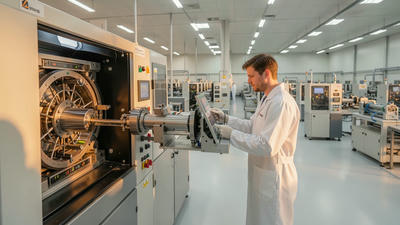
Localizing coat/develop equipment was never just about building a machine; it required mastering nuanced process control. Key challenges include achieving ultra‑uniform resist coating across large wafers, controlling edge bead removal, managing bake plate temperature profiles, and ensuring stable, repeatable development chemistry and flow dynamics.
These factors are tightly linked to resist formulations, process recipes, and lithography conditions. Local suppliers had to co‑develop with chemical vendors and fabs, iterating designs to minimize defects, improve uniformity, and integrate seamlessly with existing scanner workflows and automation systems.
The fact that localization has reached 30% suggests that many of these hurdles have been overcome to a degree acceptable for production use, not just for experimental or mature‑node applications.
Node coverage: from mature to advanced processes
Early localized coat/develop tools often entered fabs through mature nodes, where patterning requirements are less stringent and yield tolerances wider. Over time, success at mature nodes allowed vendors to push into more demanding processes, including leading‑edge logic and advanced memory nodes.
Breaking the 30% threshold typically indicates that localized tracks are not confined to legacy lines. Some share of their installed base is likely operating on mid‑range or even advanced nodes, demonstrating sufficient performance to support tight critical dimension and overlay specifications.
This breadth of node coverage is significant: it means local suppliers are not just filling low‑end gaps, but are increasingly relevant to strategic, high‑value production lines.
Supply‑chain resilience and risk diversification

From an industry perspective, higher localization in coat/develop equipment directly improves supply‑chain resilience. Fabs gain alternative sources for critical tools, reducing exposure to export controls, political tensions, or disruptions at a single global supplier.
Risk diversification is especially important when coat/develop tools sit in front‑line production for high‑volume parts. If a fab can source tracks from multiple vendors—including domestic ones—it is better positioned to maintain operations during unexpected constraints, whether they stem from logistics, regulatory changes, or supplier‑specific issues.
The 30% milestone thus serves as a tangible marker that risk is more spread out than in past eras when nearly all tracks came from a handful of suppliers concentrated in specific countries.
Bargaining power and pricing dynamics
Localization also affects bargaining power. When a fab has credible domestic or regional alternatives for coat/develop tools, its negotiations with incumbent suppliers change. Competition can exert downward pressure on pricing, encourage more flexible service terms, or accelerate support for specialized process needs.
At the same time, local vendors, aware of the strategic value of their position, may command premium pricing for certain features or customization, especially where their proximity and responsiveness are advantageous. Overall, the presence of multiple capable suppliers reshapes market dynamics away from near‑monopoly conditions.
Breaking 30% localization suggests the competitive landscape has reached a point where pricing, service, and innovation are actively influenced by the existence of localized tracks, not just by global incumbents.
Integration with local chemical and resist ecosystems
Coat/develop tools interact closely with photoresists and associated chemicals. As localization advances, these tools tend to be co‑developed with domestic chemical suppliers, creating tighter integration between hardware and materials at the local level.
Such integration can yield process advantages: tuned resist formulations for specific track designs, faster iteration cycles for new recipes, and better joint optimization of defectivity and throughput. It also anchors more of the value chain domestically, spreading economic benefits across equipment, materials, and service providers.
This ecosystem effect magnifies the significance of the 30% threshold: localized tracks help foster local resist and chemical industries, which in turn reinforce the attractiveness and capability of domestic coat/develop solutions.
Impact on fab automation and data infrastructure
Modern coat/develop tools are deeply embedded in fab automation systems, recipe management, and data analytics platforms. Localization requires full compatibility with local manufacturing execution systems (MES), automation standards, and yield monitoring frameworks.
As more localized tracks are deployed, fabs gain experience integrating domestic platforms into their data stacks, enabling richer local analytics, tailored dashboards, and faster feedback loops between process engineers and tool vendors. This can improve responsiveness to yield excursions and facilitate continuous improvement.
Breaking 30% means a non‑trivial portion of track‑related data now flows through domestic software and support systems, strengthening local capabilities in manufacturing analytics and process optimization.
ESG and sustainability angles
Localization of coat/develop equipment can carry environmental and social dimensions as well. Local manufacturing may shorten supply chains, reduce shipping‑related emissions, and support regional job creation. Domestic vendors may also be more responsive to local regulatory requirements and sustainability goals, such as solvent recycling, energy efficiency, and waste reduction.
As ESG criteria become more important in semiconductor procurement and investment decisions, localized tracks that align with national sustainability strategies can offer additional value to fabs and policymakers beyond pure technical performance.
Reaching 30% localization suggests that such ESG considerations are beginning to intersect with equipment strategy in a meaningful way, shaping future design and operational priorities for coat/develop platforms.
Challenges that remain beyond the 30% milestone
Despite the significance of breaking 30%, localization is far from complete. Many fabs still rely heavily on global suppliers for their most advanced lines, and certain specialized features—such as highly customized bake processes or extreme uniformity requirements—may remain domains of incumbent vendors.
Local suppliers must continue improving reliability, global support networks, and advanced process libraries to compete at the very top end. They also face challenges in scaling production capacity, attracting and training sufficient engineering talent, and maintaining rapid innovation cycles.
The 30% mark should be seen as a strong foothold rather than an endpoint, and the next phase of localization will likely be harder, focusing on closing gaps at cutting‑edge nodes and expanding international presence.
Implications for global incumbents
For established coat/develop equipment makers, rising localization rates present both a competitive challenge and a strategic impetus. They may need to adjust product strategies, service models, and partnership approaches in regions where domestic vendors are gaining ground.
Some incumbents might respond by increasing local content in their own offerings, forming joint ventures, or tailoring platforms to integrate better with domestic ecosystems. Others may focus on differentiating at the highest‑end technology nodes, where barriers to entry remain high.
In any case, breaking 30% localization changes how incumbents view certain markets: no longer purely captive, but contested spaces requiring renewed focus on value, innovation, and collaboration.
Strategic significance for national and regional initiatives
From a policy standpoint, the first breach of 30% localization in coat/develop equipment is a symbolic and practical achievement. It offers proof that long‑term investment in domestic semiconductor equipment can yield results, even in complex tool categories closely tied to global technology leaders.
It also provides a stronger foundation for broader localization strategies across the fab tool stack—encouraging similar efforts in etch, deposition, metrology, and back‑end equipment. Success in coat/develop builds confidence that other critical tool segments can be tackled with sustained programs and partnerships.
For regions seeking greater technology sovereignty, this milestone will likely be highlighted in reports, funding proposals, and diplomacy, serving as evidence of progress and a baseline for further ambitions.
Looking ahead: beyond 30% and toward balanced ecosystems
Looking forward, the industry will watch whether coat/develop localization rates continue to climb—to 40%, 50%, or beyond—and how that growth is distributed across nodes and regions. The long‑term goal is not necessarily total localization, but a balanced ecosystem where domestic and global suppliers coexist, providing resilience, innovation, and competitive tension.
Future developments may include deeper co‑design between localized tracks and domestic lithography, resist, and metrology tools; expanded exports of localized equipment to other countries; and greater emphasis on software, data integration, and AI‑driven process control as differentiators.
In this evolving landscape, the initial breakthrough above 30% stands as a turning point: a clear signal that coat/develop equipment, once seen as a near‑monopoly domain of a few global players, is entering a more distributed, dynamic phase. For fabs, vendors, and policymakers alike, understanding and shaping this transition will be a key part of semiconductor strategy in the years ahead.