Why Semi Material Suppliers Generally Have Higher Gross Margins than Equipment Makers
Why Semi Material Suppliers Generally Have Higher Gross Margins than Equipment Makers
Within the semiconductor ecosystem, two groups of companies are structurally critical: equipment makers that build the tools used in fabrication, and material suppliers that provide wafers, gases, chemicals, photoresists, targets, and numerous other inputs. Although both operate in demanding, capital‑intensive environments, semi material suppliers typically achieve structurally higher gross margins than equipment manufacturers. This outcome can seem counterintuitive at first glance—tools are expensive and complex—but it makes sense once you examine business models, product lifecycles, and the nature of recurring demand.

This blog post explores the key reasons behind this margin gap. It looks at how revenue is generated and recognized, why consumables tend to support higher and more stable gross margins, how technology and customer relationships shape pricing power, and what this means for investment, competition, and long‑term industry structure.
Different business models: tools vs. consumables
Equipment makers primarily sell capital goods: lithography scanners, etchers, deposition tools, metrology systems, and related hardware. These tools involve large, one‑time or infrequent transactions with long decision cycles. A single tool can cost tens of millions of dollars and may remain in service for many years, generating follow‑on revenue through spare parts and services, but the core sale is episodic rather than continuous.
Material suppliers, on the other hand, sell consumables that fabs must purchase continuously as long as they process wafers. Silicon wafers, photoresist, gases, slurries, pads, and high‑purity chemicals are used up in the course of manufacturing, so demand is directly tied to wafer starts and process complexity. This creates a recurring revenue pattern: every production run triggers material consumption that must be replenished.
These differing models—capital goods versus consumables—are the starting point for understanding why gross margins tend to diverge between equipment and material firms.
Revenue recognition and utilization leverage
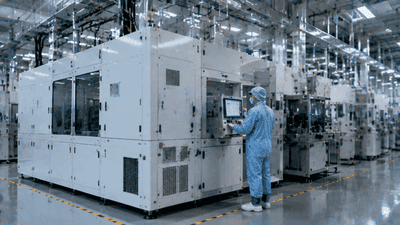
For equipment makers, revenue recognition usually spikes around tool shipments and installations, followed by steadier streams from services, upgrades, and spare parts. Their gross margins must accommodate high manufacturing and engineering costs concentrated around these big ticket items, and competition can drive substantial discounting, especially in segments with multiple capable vendors.
Material suppliers, by contrast, benefit from utilization leverage. As fabs increase wafer starts or run more complex processes, material consumption rises almost linearly, often with limited incremental manufacturing cost per unit beyond raw inputs and operational efficiencies. This recurring pattern allows material suppliers to sustain margins across cycles—when tools orders ebb, materials consumption often remains more stable, especially in mature nodes serving broad end markets.
The smoother, utilization‑linked revenue stream of materials gives suppliers more flexibility in managing production, pricing, and cost control, supporting higher average gross margins.
Cost structure differences: fixed vs. variable profiles
Equipment makers carry large fixed cost bases. Designing and producing complex tools requires extensive R&D, precision manufacturing facilities, specialized components, and long qualification cycles. Many costs must be incurred upfront, before tools are sold in volume, making profitability highly sensitive to shipment levels and product mix.
Material suppliers also invest heavily in R&D and in high‑purity manufacturing, but their cost structure typically has a more balanced mix of fixed and variable costs. Once a material production line reaches steady state and is tuned for quality, incremental units can be produced with relatively predictable variable costs, often benefiting from economies of scale and process optimization.
This structural difference means that materials businesses can maintain gross margins even during moderate downturns, while equipment makers may see more pronounced margin pressure when tool shipments slow.
Recurring revenue and customer lock‑in

Materials are deeply embedded in fab processes. Once a particular wafer, resist, gas, slurry, or other material is qualified for production, changing suppliers or formulations requires extensive requalification: test lots, defect analysis, electrical characterization, and reliability checks. Fabs are reluctant to switch materials frequently because the risk of yield loss or reliability issues can be high.
This qualification barrier creates a form of customer lock‑in for material suppliers. While price remains important, the cost and risk of switching give incumbent suppliers meaningful pricing power and support stable margins. Equipment vendors also benefit from lock‑in to some extent—once a tool is installed, fabs often buy spares and services from the original maker—but fabs frequently evaluate multiple tool vendors when expanding capacity, creating more price competition at the point of sale.
In materials, the constant consumption and higher switching friction reinforce gross margins more directly and consistently than in tools.
Value‑added chemistry and differentiation
Many semiconductor materials are not commoditized chemicals; they are highly engineered products tailored to specific processes and devices. Advanced photoresists, ALD precursors, CMP slurries and pads, and specialty gases and wet chemicals all involve complex formulation know‑how, tight impurity control, and fine‑tuned performance characteristics that directly impact device yield and reliability.
Because the value that these materials provide is intimately tied to their chemistry and performance, suppliers can differentiate their products and justify premium pricing. Fabs are willing to pay more for materials that reduce defects, improve uniformity, or enable tighter design rules, because these improvements translate directly into higher die yield and performance.
Equipment makers also innovate and differentiate, but competition among a small group of high‑end tool vendors and the visibility of tool purchase prices tend to limit how far gross margins can stretch, especially in segments where multiple tools offer similar performance.
Portfolio breadth and process integration

Leading material suppliers frequently offer broad portfolios that cover multiple process steps and modules: wafers, resists, CMP consumables, cleans, etchants, and more. This breadth allows them to integrate solutions, co‑optimize materials across steps, and deepen relationships with fabs. They can capture more value from each wafer by supplying several different consumables that work well together.
This portfolio effect supports upselling and cross‑selling, as fabs may prefer to source compatible materials from a single trusted supplier rather than piecing together products from many vendors. It also allows suppliers to negotiate value‑based pricing across bundles rather than on individual materials alone.
Equipment vendors can and do bundle tools, services, and software, but each major tool category often faces separate competitive dynamics, and capital budget constraints can force fabs to diversify tool vendors more than material suppliers.
Balance of competition and concentration
The competitive landscape differs between the two sectors. In some equipment categories—especially lithography—competition is limited, which can support strong margins. However, in many tool segments (etch, deposition, metrology) multiple global and regional players compete, exerting pricing pressure.
By contrast, numerous high‑value material segments are dominated by a small set of global leaders who have accumulated decades of process expertise and trust: in wafers, advanced resists, CMP, and specialty gases and chemicals. This concentration, combined with high qualification barriers, often results in less intense price competition at the high end.
While both sectors have oligopolistic structures in certain niches, the breadth of high‑margin niches is often greater in materials, leading to stronger average gross margins across portfolios.
Lifecycle and upgrade dynamics
Equipment lifecycles are often measured in years to decades. Once a tool is installed, fabs may run it for a long time, upgrading components or adding new process recipes. Equipment makers earn revenue from these upgrades and services, but the initial tool sale remains a dominant event in the lifecycle.
Materials, however, have shorter lifecycles in terms of formulations and specifications. New nodes, device architectures, or reliability requirements frequently drive demand for improved or entirely new materials: a new resist chemistry for a tighter pitch, a refined precursor for a novel film, or a new CMP slurry tailored to fresh interconnect structures. Each new generation can command higher value if it improves performance, enabling material suppliers to refresh their portfolios and sustain margins.
This dynamic of iterative, value‑enhancing updates meshes naturally with the recurring consumption model, allowing material suppliers to capture margin from both volume growth and technology upgrades.
Cyclicality and margin resilience
Both equipment and materials businesses are cyclical, tied to semiconductor demand and fab investment. However, the amplitude of cycles differs. Equipment orders are closely linked to capital spending cycles; during downturns, fabs often delay or cancel tool purchases, causing sharp drops in equipment revenues and pressure on margins.
Materials consumption, while affected by overall wafer volumes, tends to be more resilient. Fabs still process wafers to fulfill existing product demand, service long‑term contracts, and maintain lines for strategic reasons. Even in downturns, they must purchase consumables, though possibly at reduced rates. As a result, material suppliers may see slower growth or modest declines, but their revenue base usually remains more stable than that of equipment vendors.
This relative resilience helps support higher average gross margins over the cycle, even if peak margins can be comparable in certain high‑end equipment segments.
Qualification barriers and switching costs
Switching materials can be more complex and risky than switching tools. If a fab changes a critical material—such as a cleaning chemical, CMP slurry, or resist—subtle process interactions may alter defectivity or electrical characteristics. Extensive requalification is needed to regain confidence, often involving significant cost and time.
Equipment changes also require qualification, but new tools often replace older ones in the context of broader capacity expansions or technology transitions. Fabs already anticipate investment and engineering effort when installing new tools, making substitution more feasible during scheduled upgrades.
The higher everyday friction of changing materials reinforces the pricing power and gross margins of incumbent material suppliers in ways that do not have a direct equivalent for equipment makers.
Raw material exposure and value capture
Equipment makers use multiple raw materials and components—metals, electronics, optics—and must manage cost fluctuations in these inputs. While sophisticated supply management can mitigate risk, raw material volatility can still pinch margins, especially when competitive pressures limit the ability to raise tool prices quickly.
Material suppliers also face raw material costs, particularly in chemicals, gases, and metal‑based products like sputtering targets. However, their ability to capture value through tailored purification, formulation, and application engineering can buffer the impact of raw input swings, as customers focus more on performance than on underlying commodity costs.
In segments where differentiation is high, material suppliers can pass through a portion of raw material cost changes while preserving margins built on intellectual property and process value‑add.
Implications for strategy and investment
The structural margin differences between material suppliers and equipment makers influence strategic behavior. Material companies often prioritize expanding high‑value product lines, deepening process integration with fabs, and investing heavily in R&D for differentiated chemistries. Their higher gross margins can support sustained investment and acquisitions in adjacent segments.
Equipment makers focus on developing breakthrough tools, scaling manufacturing, and maintaining tight relationships with leading fabs. While they may not enjoy the same average gross margin levels, their products can command significant absolute profits on high‑value systems and build formidable barriers to entry through technology and installed base.
For investors and industry observers, understanding these margin structures helps explain why materials businesses are often viewed as steady, high‑quality earnings platforms, while equipment companies are seen as more cyclical but capable of strong returns during upturns.
Conclusion: structural reasons behind higher material margins
Semi material suppliers generally achieve higher gross margins than equipment makers because of deep structural features: recurring consumption tied to wafer processing, strong customer lock‑in via qualification barriers, high value‑added chemistry and process integration, and relatively resilient demand across cycles. Equipment makers, though technologically sophisticated and crucial to capacity expansion, operate in a capital‑goods model where revenues and margins swing more sharply with investment cycles and competition.
Recognizing these differences clarifies why materials businesses occupy a distinct financial niche within the semiconductor industry. They form a stable, high‑margin backbone of consumables that quietly but significantly shapes the economics of chip manufacturing, even as the more visible equipment makers drive the front‑page stories of new fabs and cutting‑edge tools.